
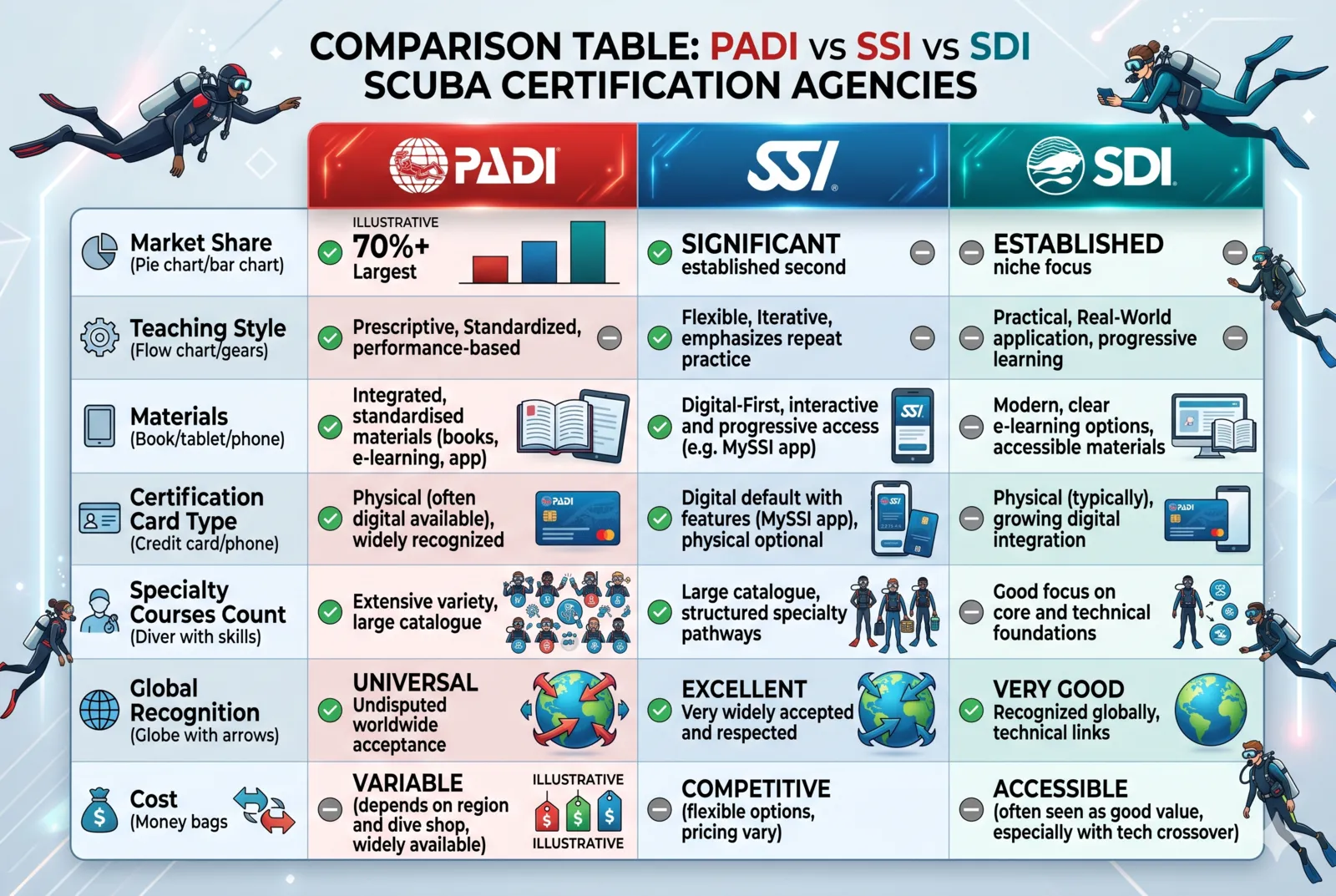
PADI vs SSI vs SDI — Which Diving Certification Should You Get?
Unbiased comparison of the three major diving agencies. Curriculum, recognition, teaching style, and which is best for you.
Why does it matter which agency you choose?
A diving certification from PADI, SSI, or SDI is internationally recognized and valid for life. You can dive anywhere in the world with any of them. But here's what most beginners don't realize: the agencies have slightly different teaching philosophies, learning materials, and ongoing support models. None is objectively 'best' — they suit different learning styles and goals. Understanding the differences helps you choose the right fit for how you learn.
PADI (Professional Association of Diving Instructors)
The largest diving organization in the world with 70%+ of global divers certified by PADI. Why? Excellent brand recognition, massive dive site network (PADI-affiliated shops worldwide), traditional classroom-based curriculum with paper certifications, and consistent standards globally. PADI's approach: structured, systematic, very by-the-book. Lessons flow in a precise sequence, each skill builds on the previous one. Great for detail-oriented learners and people who like clear roadmaps. PADI also has the most specialty courses available (200+), so if you want to pursue advanced training, options abound. The trade-off: PADI can feel rigid if you prefer exploratory learning, and it's older-school in its digital materials. We use PADI because of the recognition and course availability, though we adapt teaching to individual learning styles.
SSI (Scuba Schools International)
The digital-first diving agency. SSI replaced paper workbooks with an online learning platform where students dive deeper into topics they're curious about and move quickly through sections they grasp. The curriculum is identical to PADI in terms of safety and core skills, but the teaching is more flexible and personalized. SSI divers get a digital certification card and ongoing access to a learning platform for life. SSI's approach: adaptive, tech-forward, learner-centered. If you like moving at your own pace and choosing how deep to go into topics, SSI's structure is ideal. The trade-off: fewer specialty courses than PADI (though still 100+), and some dive resorts preferentially recognize PADI. SSI is growing rapidly and is equally safe and respected, but less ubiquitous.
SDI (Scuba Diving International)
Built on the PADI model but with some tweaks. SDI was created by TDI (Technical Diving International) and focuses on technical skills and advanced training from the start. The intro-level curriculum is virtually identical to PADI, but SDI emphasizes environmental awareness and rescue skills even at the beginning level. SDI divers often describe feeling more 'rescue-ready' earlier. The teaching philosophy is practical and task-oriented. SDI's approach: skill-building focused on real-world readiness, strong emphasis on environmental stewardship, smaller but deeply committed community. The trade-off: fewer dive resorts advertise SDI partnerships (though SDI cards are recognized everywhere), and the technical emphasis might feel intense for pure recreationalists. SDI is ideal if you want solid fundamentals and plan to advance quickly.
Core curriculum: how they compare
All three cover the same essential skills: equipment assembly, buoyancy control, mask clearing, regulator recovery, pressure management, and emergency procedures. The syllabus is standardized because diving safety requires these basics. The difference is emphasis and teaching sequence. PADI: rigid sequence, each step unlocks the next. SSI: flexible, can loop back to revisit topics. SDI: practical applications emphasized early. For a beginner, the difference is subtle. By dive 5, most students feel confident regardless of agency.
Cost comparison
Open Water certification costs €400-500 across all agencies. This is standardized because shops compete on service and quality, not price. Specialty courses are typically €100-150 each, regardless of agency. Initial cost is the same; the ongoing value differs. PADI has more specialty options (more to spend on). SSI includes lifetime digital access to learning materials (potential long-term value). SDI's materials are free to use (no subscription). Over a diving career, SDI is cheapest if you value self-directed learning; PADI offers more options if you want structured progression.
After certification: what you get from each
PADI: paper card (pretty cool to frame), access to massive specialty course catalog, PADI Rec app for dive logs. SSI: digital card + lifetime access to SSI learning portal (great if you advance). SDI: digital card, free learning materials, access to TDI technical courses if you want to go deep. All three give you the same thing that matters: a lifetime certification valid everywhere and the ability to dive independently (within your level) for the rest of your life.
Which agency fits your learning style?
- **Choose PADI if** you prefer a clear, step-by-step roadmap where each skill builds on the last. PADI suits detail-oriented learners who want structured progression and the most globally recognised card. If you plan to travel widely and want maximum flexibility in which dive shops will recognise your cert, PADI is the safest choice.
- **Choose SSI if** you like learning at your own pace and want lifetime digital access to your materials. SSI suits self-directed learners who appreciate being able to revisit modules, skip ahead when they grasp concepts quickly, and reference their course content years after certifying.
- **Choose SDI if** you want to feel rescue-ready from day one and have strong ambitions to advance into technical diving. SDI suits practical, task-oriented learners who care more about real-world readiness than brand recognition, and who may eventually want to pursue TDI technical courses.
- **Still unsure?** Tell your instructor how you learn best. At DiveRED we teach all three and will match you to the platform that fits your personality — not the one that's easiest for us to teach.
Specialty courses and continuing education
All three agencies offer a pathway beyond Open Water, but the ecosystems differ. PADI has the largest specialty catalogue with 200+ options covering everything from wreck diving to underwater photography, fish identification, and search-and-recovery. If you want maximum choice in continuing education, PADI wins on breadth. SSI offers around 100 specialties and packages them into 'programs' — clusters of related courses that build a coherent skill set. The SSI My Dive Guide app tracks your progress and suggests logical next steps. SDI's specialty list is smaller but heavily weighted toward technical and safety skills: advanced buoyancy, rescue, wreck penetration, and the gateway courses into TDI tech diving. If you plan to eventually dive deep or into overhead environments, SDI's progression path is the most direct. One practical note: at most Red Sea dive centres, PADI and SSI specialty cards are accepted interchangeably. SDI cards are equally valid but less commonly advertised at resort dive desks. In practice, this rarely creates problems — dive centres check your certification level, not the issuing agency.
Digital materials, apps, and what you take home
How you learn matters as much as what you learn. PADI uses the PADI eLearning platform — solid, widely translated, available in 28 languages. You pay for the materials once and own them. After certification, PADI issues a physical card plus access to the PADI Rec app for logging dives and displaying your cert digitally. SSI is built around the SSI app, which functions as your study platform, dive log, certification wallet, and training guide for life — all in one place. There's no physical card by default, though one can be ordered. The lifetime access model is genuinely valuable: divers who return to diving after a gap can review their training from scratch at no cost. SDI delivers materials digitally as well, with free PDFs and online modules that you can revisit. Like SSI, SDI uses digital cert cards. The TDI app integrates with SDI certifications for divers planning to go technical. All three hold up fine in the real world — rental desks, liveaboards, and dive resorts worldwide accept digital cert cards.
The one thing that matters most
The agency is about 5% of the certification experience. The other 95% is your instructor, the dive sites, your diving buddies, and your own attitude toward learning. All three agencies produce equally competent divers. A good instructor from any agency beats a mediocre instructor from another agency every time. So choose based on teaching style, not brand prestige — and pick an instructor you trust. That's where the real difference is made. Ready to start? Browse our PADI, SSI & SDI diving courses in Hurghada and we'll match you with the right instructor.
More from the blog
 training
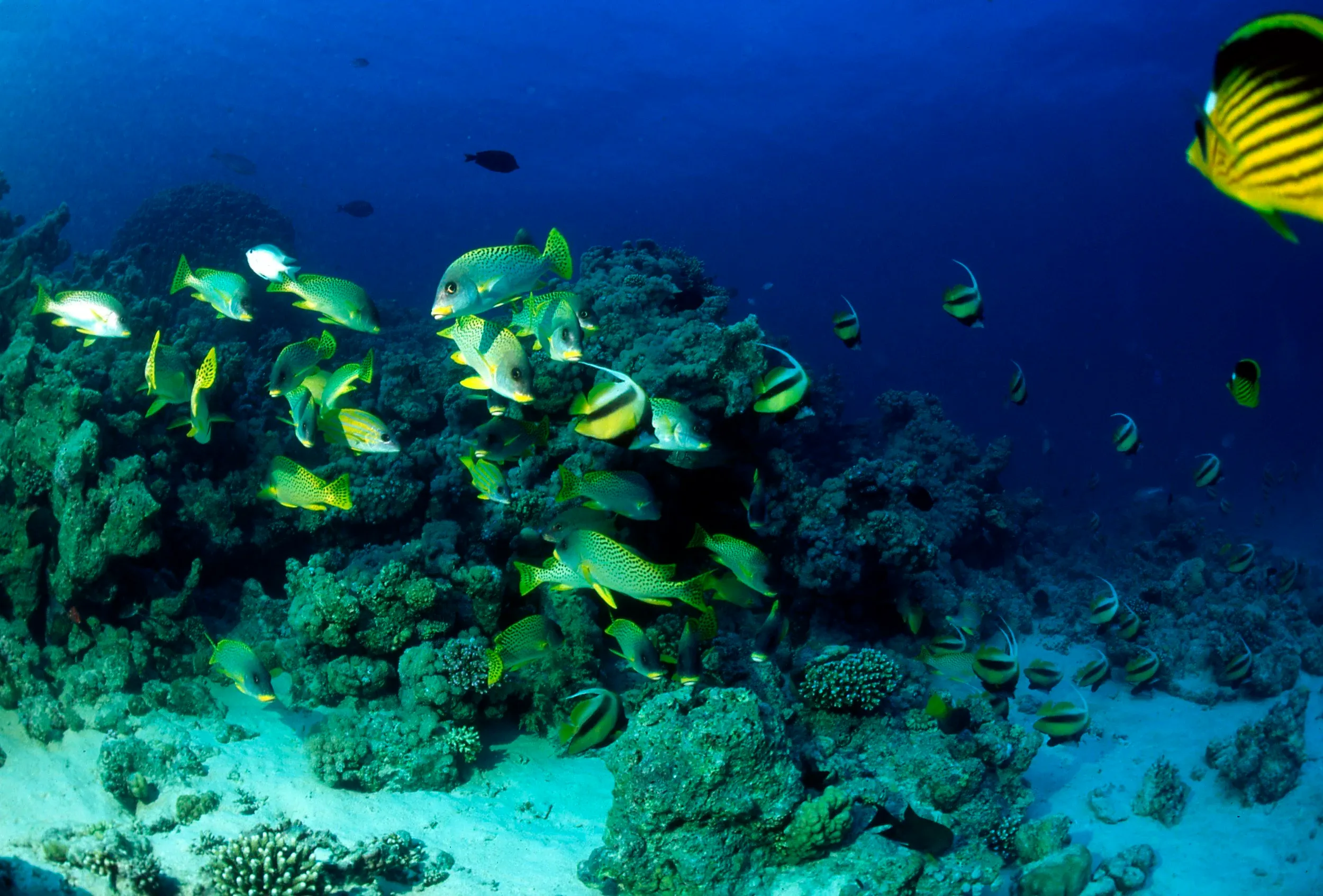
 Beginner's Guide to Diving Hurghada in 2026
Everything a first-time diver needs to know about getting certified in the Egyptian Red Sea — from cost to course choice to what to expect on day one.
 training
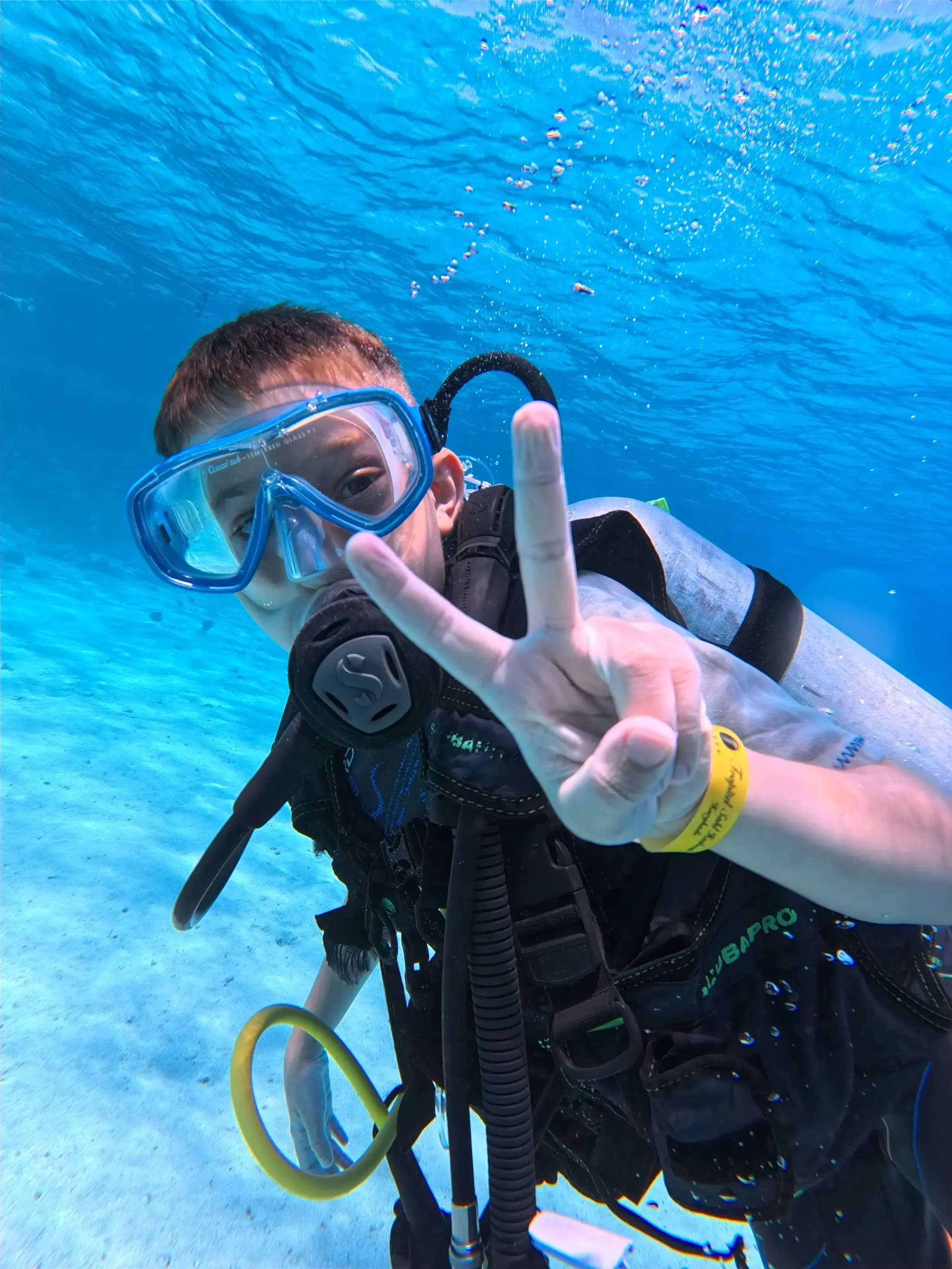
 Kids Scuba Diving in Hurghada — How Young is Too Young?
Everything parents need to know about certifying kids in the Red Sea. Age requirements, course types, safety practices, and how to know if your child is ready.
 training
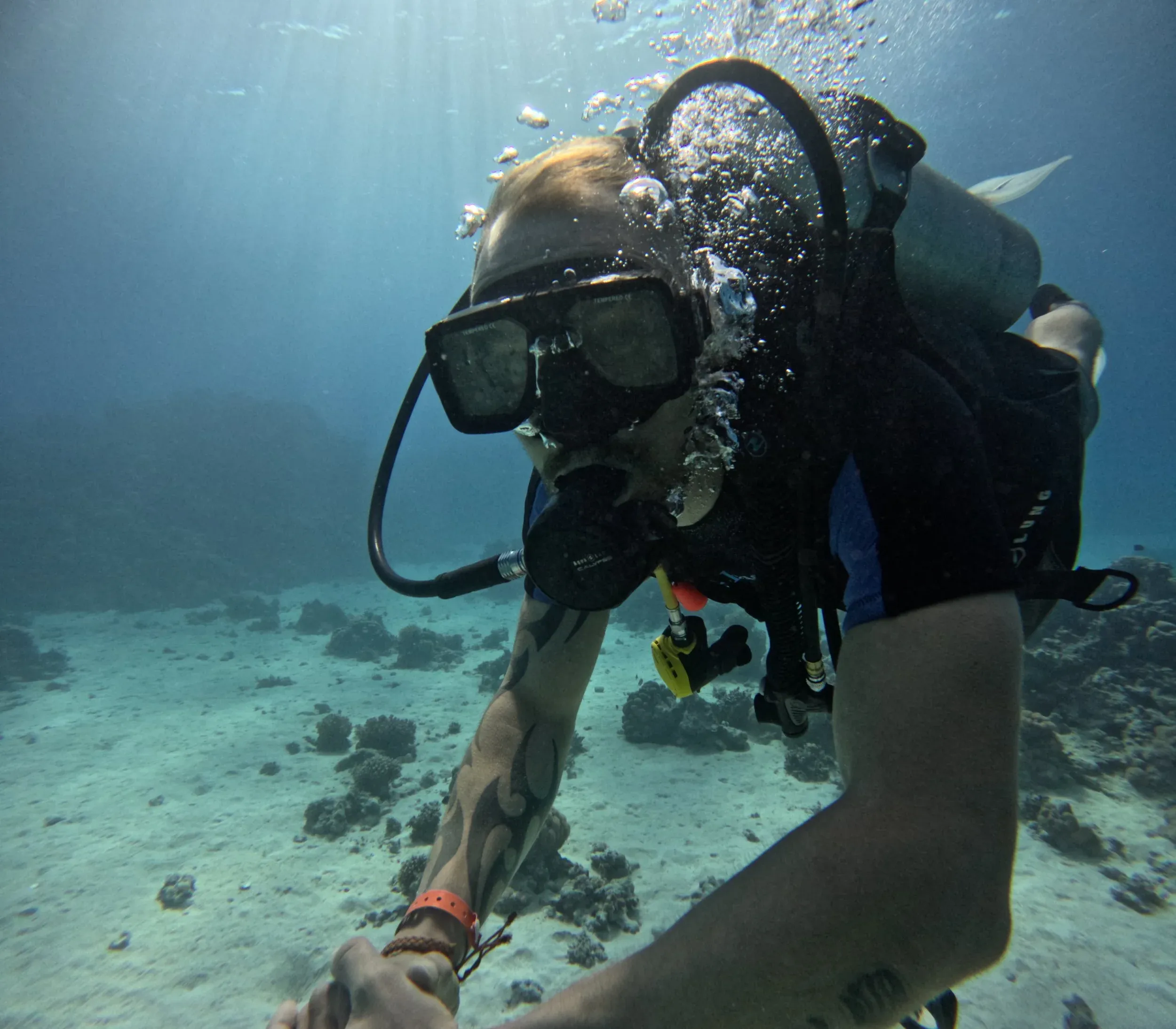
 Open Water Course in Hurghada: 2026 Price, How Many Days & What's Actually Included
The honest buyer's guide to getting scuba certified in Hurghada: what an Open Water course really costs in 2026, how many vacation days you need, the hidden fees cheap offers don't mention — and how to choose a school you'd trust at 18 metres.