
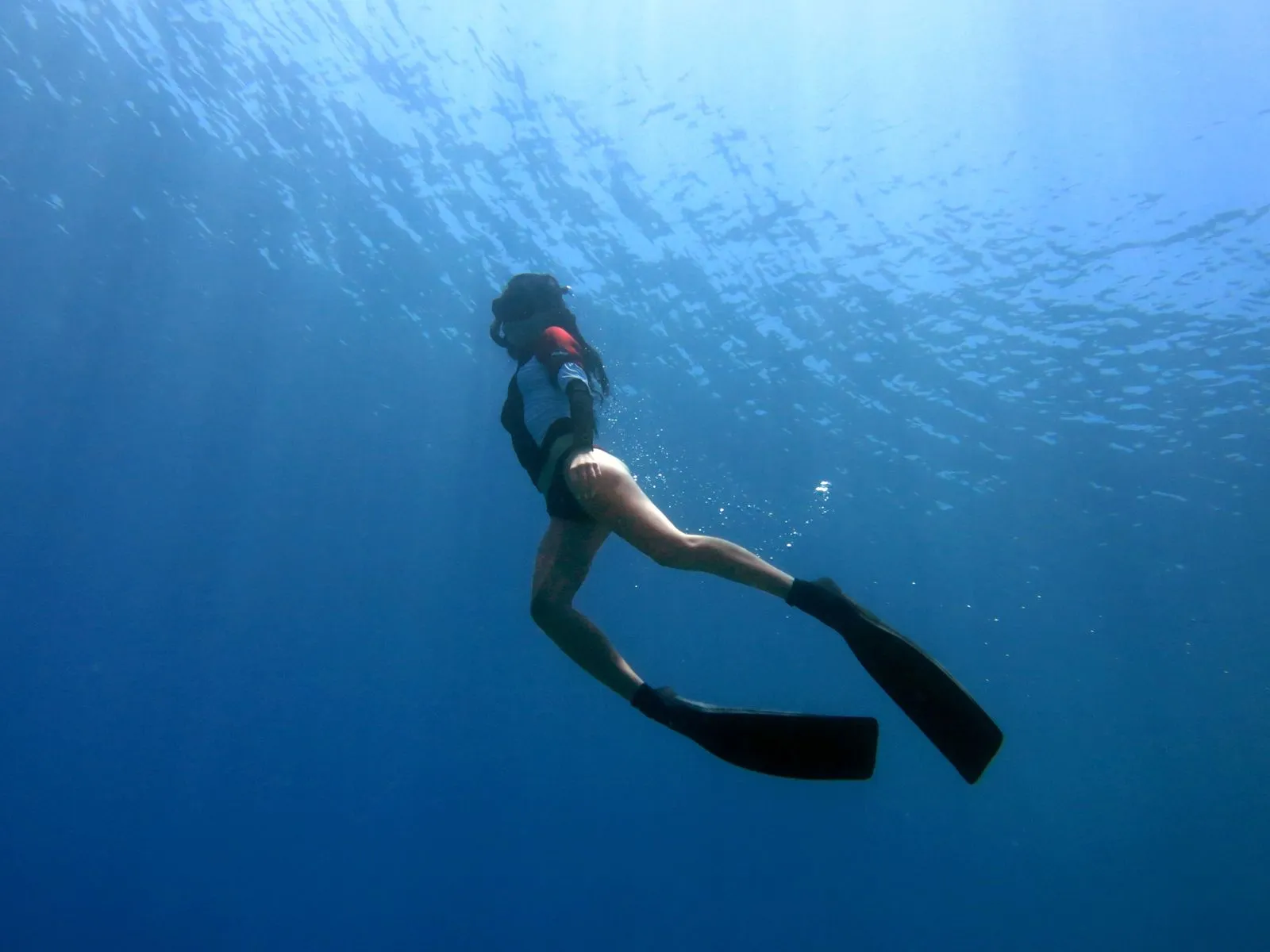
Freediving in Hurghada: An Honest AIDA Guide
What it's actually like to learn freediving in the Red Sea — the real conditions, the wall every freediver hits at 20 metres, and which AIDA level is right for you. Written by the team that teaches it.
There's a moment, usually on day one, when a student who swore they could never hold their breath surfaces from a relaxed two-minute breath-hold, pulls off their mask, and just laughs. Nothing about their lungs changed that morning. What changed is that they finally stopped fighting the water. That moment — not the depth, not the numbers — is why we teach freediving.
My first time in the water was magical — I'd never seen anything like it. Just me, my fins, and the bottomless blue, and you feel like the bottom is staring right back at you. I haven't stopped freediving since.
Why Hurghada is a quietly perfect place to learn
Freediving forgives almost nothing and punishes cold, current, and chop. Hurghada has none of those problems. The water sits between 22 and 28°C year-round, visibility is regularly over 25 metres, and on the sheltered training sites there is almost no current. You get easy access to real depth close to shore, with calm blue water and a sandy, forgiving bottom. For learning, that's about as gentle as the sea gets.
Hurghada or Dahab? Our honest take
Dahab is the famous one — the Blue Hole, the world records, the freedive-town reputation. It earned all of it, and if your goal is to chase deep personal bests on a single legendary wall, go to Dahab. But for learning, Hurghada has real advantages we won't pretend away: warmer, calmer water on the training lines, depth that builds gradually from a boat instead of dropping off a cliff edge, and far less of the competitive intensity that can rattle a nervous beginner. You learn faster when you're not also managing fear of the place itself. Many of our students come here precisely because it feels like the sea is on their side.
Almost everyone can hold two minutes with the right technique. Relaxation — not lung size — is what makes the difference.
The AIDA ladder: which level is actually for you
AIDA is the original and most recognised freediving agency, and the system is built as a ladder — each level adds skill, depth, and self-sufficiency. Here's the honest version of what each one is, with real prices and real targets: Start with AIDA 1 Discover Freediving (€99, one day, to ~10 m) if you've never done this. There's no minimum breath-hold or depth to pass — everyone moves at their own pace. Step up to AIDA 2 Freediver (€290, 2–3 days, to 20 m) for your first real certification. You'll work toward a 2:00 static, 40 m dynamic, and constant-weight depth on a line. Go deeper with AIDA 3 Advanced (€319, 3 days, to 30 m): 2:45 static, 55 m dynamic, and the technique that changes everything — the mouthfill. Finish at AIDA 4 Master (€329, 4 days, to 40 m): 3:30 static, 70 m dynamic, and a full unconscious-diver rescue from 20 m. It's the top recreational level and the gateway to teaching.
Why the reef treats freedivers differently
Scuba is loud. The bubbles, the exhale, the clatter of gear — fish read all of it as 'large, strange, noisy animal' and keep their distance. Freediving is silent. No bubbles, no engine of breath, just a quiet shape gliding through. The animals notice. A green turtle resting on the sand — they can hold their breath over an hour — will often let a still freediver drift surprisingly close before easing up for air. A day octopus, curious by nature, will reach an arm toward a diver who simply hovers and waits. Napoleon wrasse on our reefs are tame enough to come right up to your mask. You don't chase any of it. You go quiet, and the Red Sea comes to you.
What freediving gives back
Freediving reaches people scuba sometimes can't. One of our divers came to us after a back surgery had ended their scuba days — and found the sea again, in a quieter, lighter way. In their own words:
I always loved scuba diving — being under the sea, surrounded by fish, it's unbelievable. But after my back surgery I thought I could never do it again. Then I met Samy, and everything changed. I can dive again, in an even more special way. Even if I could go back to scuba, I'd still choose freediving.
Common questions before your first course
A few honest answers to what people ask us most before booking.
Can I freedive if I can't hold my breath for long?
Almost certainly yes. There's no minimum breath-hold to start AIDA 1, and most people reach a relaxed two-minute static by the end of AIDA 2. Breath-hold is a technique and relaxation skill, not a measure of lung size or fitness — that's exactly what we coach.
Do I need to be a strong swimmer?
For AIDA 1 Discover you just need to be comfortable in the water — no swim test. AIDA 2 asks for a 200 m continuous swim without fins. Comfort and calm matter far more than speed.
Is freediving safe?
It's very safe when you follow the rules the course teaches: you always dive with a trained buddy, one person down and one watching, never alone. A short medical questionnaire is required before you start. Most of an AIDA course is, in fact, learning exactly these safety habits.
How deep will I actually go?
It builds gradually: about 10 m on AIDA 1, 20 m on AIDA 2, 30 m on AIDA 3, and 40 m on AIDA 4 — each level only after you're relaxed and equalising comfortably at the previous depth. Nobody is pushed.
Ready for your first breath?
Freediving and scuba aren't rivals — plenty of our divers do both, and a freediving foundation makes you calmer and more efficient on a tank too. If you're curious where to begin, read the full freediving programme, or if you're coming from the surface, our snorkeling trips are a gentle first step into the same water. When you're ready, browse the AIDA courses and message us on WhatsApp — we'll match you to the right level and the right instructor. Small groups, your own pace, one breath at a time.
More from the blog
 guides
 When is the best time to dive Hurghada?
A month-by-month guide to water temperature, visibility, marine life, and crowds in the Egyptian Red Sea — and which months we'd actually choose if we could only dive Hurghada once.
 guides
 Private Diving vs Group Dives in Hurghada — Which Should You Choose?
Full comparison of private dives and group trips in the Red Sea. Cost, benefits, when each makes sense, and how to get the most from either option.